
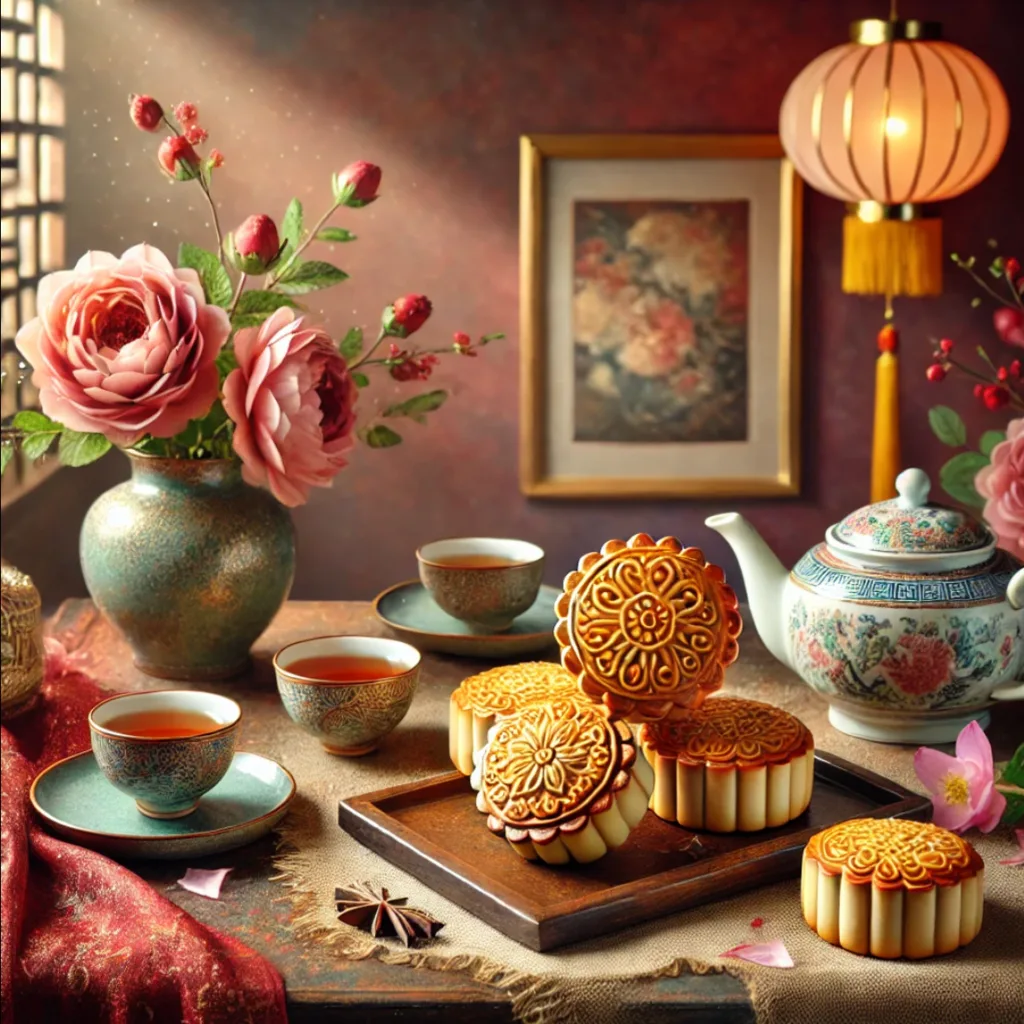
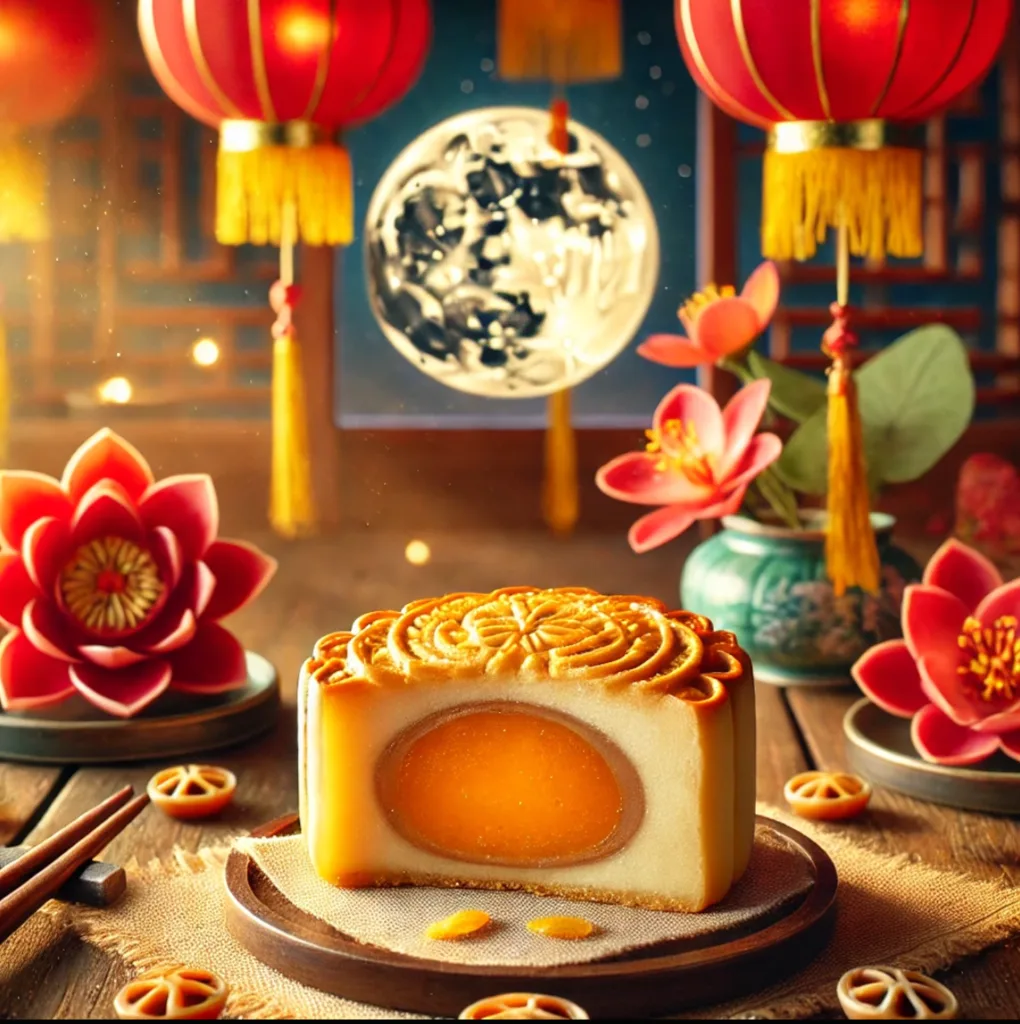
A symbol of Chinese cultural heritage, mooncakes are a type of pastry traditionally eaten during the Moon Festival. This Mid-Autumn festival is one of the four most important Chinese festivals; while it is mainly about the harvest, legend connects it to moon watching. During the festival mooncakes are served and shared between family and friends. Mooncakes are generally round, although they can sometimes be square, and they have a thick pastry shell which encases either a sweet or a savoury filling. Approximately 10cm in diameter and 3-4cm thick, mooncakes are steamed, baked or fried, depending on the custom. They usually contain one or two whole salted egg yolks in the centre to represent the full moon, and are generally eaten in small wedges with tea. Traditionally, mooncakes are imprinted on the top with the Chinese characters for ‘harmony’ or ‘longevity’ and decorated with flowers, vines, or a rabbit, which is a symbol of the moon. They are so rich and dense that it is usually wise to limit yourself to one per day.
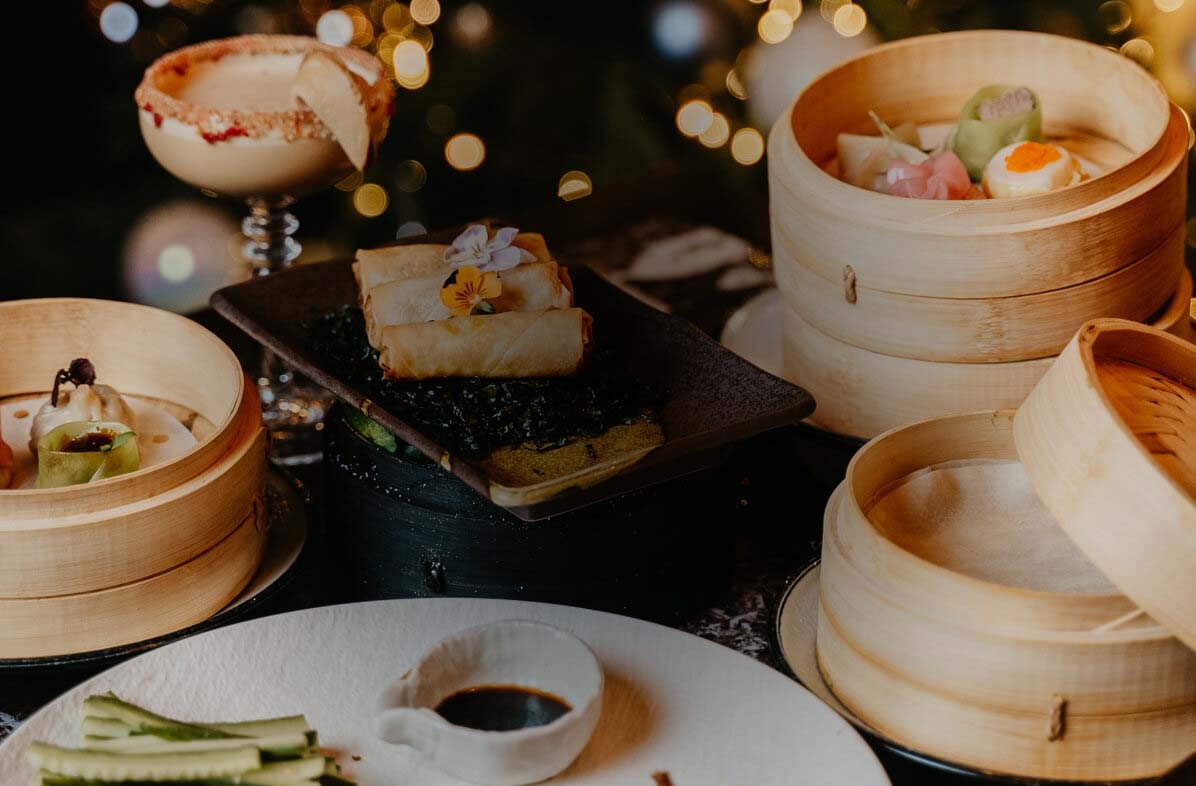
A traditional restaurant, Lulu Wild is the perfect place to celebrate Chinese culinary heritage, serving authentic food cooked by native chefs. Our mooncakes are prepared using authentic recipes and quality ingredients, allowing everyone to appreciate their delicious taste and their cultural significance.
The Moon Festival
The Mid-Autumn festival, known as the Moon Festival, is linked to the legends of Chang’e, the mythical Moon Goddess of Immortality. According to the Liji, an ancient Chinese book recording customs and ceremonies, the Chinese Emperor was expected to offer sacrifices to the Sun in spring and the Moon in autumn. Mid-Autumn is considered to be the 15th day of the 8th lunar month, the night being called the “Night of the Moon”. Mooncakes became a popular delicacy for the Mid-Autumn festival and they have remained popular to this day. Now they form a central part of the celebration, which to some has become known as the “Mooncake Festival”.
The myth of the Moon Festival is well known in Chinese culture and can be traced back to the Huainanzi, the writings of the Prince of Huainan, a philosophical book from the Western Han dynasty. It begins in the Tang dynasty (618-907 C.E.), when China was suffering from extreme heat. Crops began to dry up and villagers started to perish under the sun. There were ten scorching suns circling the Earth, so the Imperial Court called upon Hou Yi, a skilled archer, to shoot down nine of them. Yi was successful and saved humanity. To thank the hero, the moon gods gave the archer two elixirs which granted him everlasting life. The fame, however, got to Yi’s head, and he became a tyrant. His wife, Chang’e, witnessed how her husband’s personality had changed and became concerned that if he consumed the elixirs, he would be uncontrollable and unstoppable. As a sacrifice, Chang’e swallowed both of the elixirs, and as a reward for her selflessness, the moon gods floated her to the moon. During the Moon Festival, the Chinese look up to the moon in her honour.
Origins of the mooncake
Mooncakes are a symbol of the full moon and are often given as gifts to strengthen relationships and express good wishes. The most popular mooncake folk tale has them used by revolutionaries in an effort to overthrow the Mongol-led Yuan dynasty. The idea came from Zhu Yuanzhang and his advisor Liu Bowen, who created a rumour that a deadly plague was spreading and the only way to prevent contracting it was to eat special mooncakes. These mooncakes were said to instantly revive those who consumed them, giving them special powers. As a result, there was an increase in the production of mooncakes, which were made and distributed quickly. These mooncakes contained secret messages aimed at overthrowing the rulers. The messages were printed on the surface of the mooncake as a simple puzzle or mosaic; to solve the puzzle, the mooncakes (which came in packs of 4) would be cut into four parts, and all 16 pieces were then assembled to reveal the message, before being eaten, destroying the evidence.
Other tales about mooncakes include events that happened in the Tang dynasty. In the first tale, Emperor Taizong, who reigned from 626 to 649, gave mooncakes to court ministers on the 15th day of the eighth lunar month, in celebration of a victorious battle against the Turks. In the second version, Emperor Xizong, who ruled from 873 to 888, offered round-shaped cakes to candidates who were successful in the imperial service examinations for their hard work.
Types of Mooncakes
Fillings
Traditional mooncakes included a variety of different fillings, including:
- Lotus seed paste: Often considered to be the original and most luxurious mooncake filling. Due to the high price of lotus paste, white kidney bean paste is often used as an alternative filler.
- Sweet bean paste: Red bean paste, made from azuki beans, is the most common, but this paste can also be made from mung beans or black beans.
- Jujube paste: This sweet paste is made from the ripe fruits of the jujube (date) plant. Fruity and smoky, with a slightly sour taste, this paste is dark red in colour and is often confused with red bean paste.
- Five kernels: Five types of coarsely chopped nuts and seeds, held together with maltose syrup. These usually include walnuts, pumpkin seeds, watermelon seeds, peanuts, sesame seeds or almonds. It may also contain candied winter melon, jinhua ham, or pieces of rock sugar.
Crusts
The type of crust used generally depends on the region in which the mooncakes were produced. The common types of mooncake crusts include:
- Chewy: The most common type of crust, with a reddish-brown tone and a glossy sheen, made from a thick sugar syrup, lye water, flour and oil.
- Flaky: Similar to puff pastry and typically from Suzhou or Taiwan, this dough is made by rolling together alternating layers of oily dough and flour that has been stir-fried in oil.
- Tender: Closer to a shortcrust pastry, this tender crust is made mainly of a homogenous mix of sugar, oil, flour and water.
- Crumbly: A Yunnan-style mooncake, this crust is made using a hot water crust pastry that combines different kinds of flour with oil, salt and hot water to form a dense, crumbly pastry.
Over the years, both the crusts and the fillings of mooncakes have diversified, partly through a commercial need to drive up sales, partly to cater to changing tastes and more health-conscious eaters. Traditional mooncakes are often sold alongside contemporary ones to cater to individual preferences. Fillings in contemporary mooncakes include taro paste and pineapple, coffee, chocolate, nuts, fruits, vegetables and ham, as well as cream cheese, tiramisu, green tea and even ice cream.
Explore the Traditions and Flavours of Chinese Culture
Mooncakes have a rich history, and they sit at the centre of one of China’s biggest festivals. To fully embrace the culture and explore the flavours of mooncakes and the other traditional food of China, visit Lulu Wild.