
We dine out for all sorts of reasons. Sometimes it's convenience, sometimes it's a romantic date night, and sometimes it's business: networking, or closing a deal. Correct dining etiquette is essential if you want to make a strong impression. It matters less when you're casually dining out or on a date, but it's of the utmost importance in situations like business meetings, where first impressions are everything.
The problem most people face is that they don't know all the rules of dining etiquette. That's why we've put together this guide, to help you understand what dining etiquette is, why it's important, and how to make a good impression at those important dining events.
Dining Etiquette Rules of Engagement
Let's break down all the rules of dining etiquette and look at not just what you should do, but how you should do it and why.
Arrival
Make sure you arrive on time (or a little early), and if you know you're going to be late, call ahead to let the party know. It's just common courtesy.
Reception
Often, before formal dining commences, there will be a reception: a welcoming period that lets you network and entertain clients. During this time, there are some rules you should follow:
- When you rotate and talk to people, try to keep one hand free, preferably your right hand (dry and clean), ready to deliver handshakes.
- Stand and greet those you'll be sitting down to dine with.
- Keep good eye contact.
- Avoid interrupting people in conversation. If you see two people who appear to be deep in conversation, don't approach and interrupt; wait until there's a break in the conversation and then join them.
Sitting Down
When you sit down at the table, follow these rules:
- Keep the correct posture and always keep your elbows off the table.
- Don't place anything on the table. Briefcases, phones, bags, purses, sunglasses: all should be stored under the table or elsewhere, never on it.
- If you are the host, wait 15 minutes before you begin checking on the status of your expected guests.
Table Arrangements
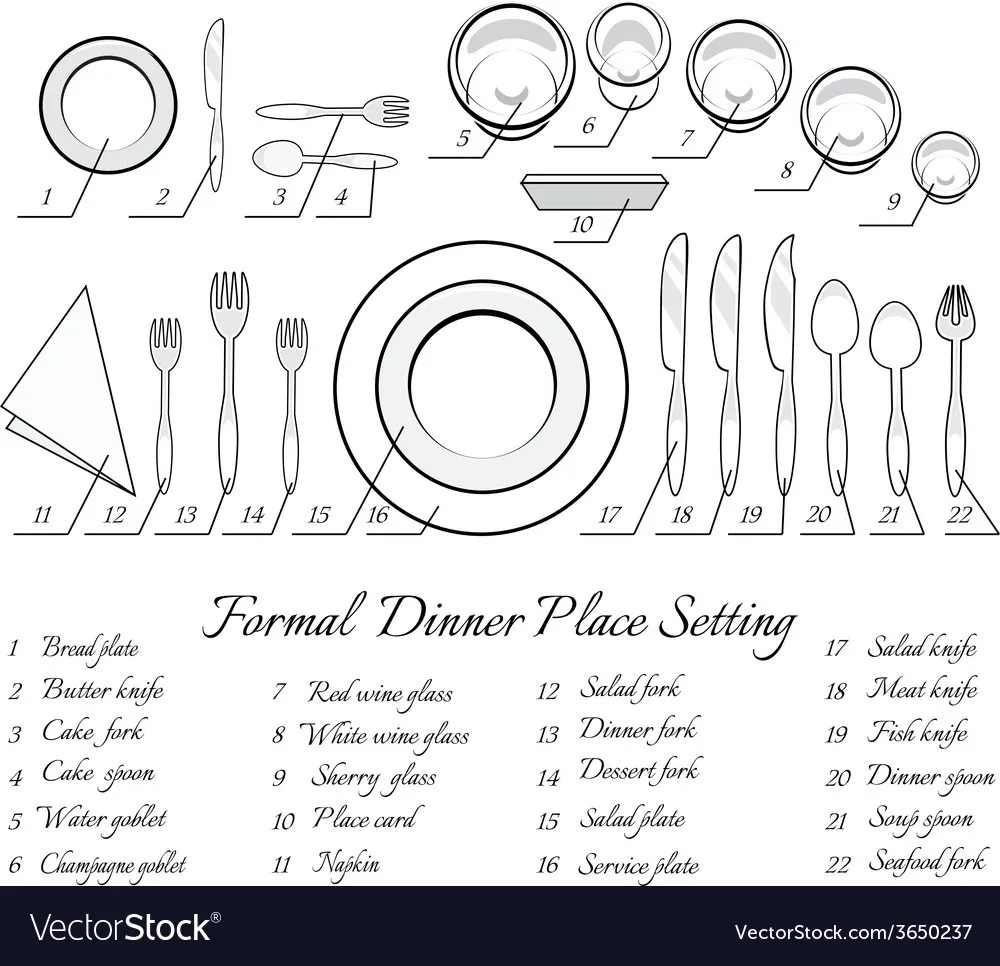
The table will be arranged in a specific way, and you need to understand this arrangement if you want to get your dining etiquette right. This is what a formal table arrangement looks like:
Eating Etiquette
Utensil etiquette:
- The table will be set with a variety of utensils, always presented in a specific way. The guideline is to start from the outside and work your way in. If you have two forks, use the one on the outside for the first course, then the next fork for the second course, and so on.
- Never hold your utensils in a fist.
- Don't talk with your utensils, and don't gesture or point with them.
- When you have finished eating, place your utensils on the plate, never on the table.
Napkin etiquette:
- Follow your host's lead on this. Typically, you should put your napkin on your lap, folded in half with the fold towards your waist. Do this soon after you sit, or as soon as your host does.
- Keep the napkin on your lap throughout the entire meal.
- If you leave the table, place the napkin on your seat or next to your plate to signal to the server that you'll be returning.
- Once the host has placed their napkin on the table, take it as an indication that the meal is finished; you can then place your napkin on the table too.
Ordering:
- Avoid ordering items that are messy to eat.
- Don't start eating until everyone has been served.
- Don't order the most expensive thing on the menu.
- Don't order alcohol. If the host orders alcohol, you may order some too, but drink in moderation.
Eating:
- Eat slowly and take small bites.
- Don't talk with food in your mouth, and chew with your mouth closed.
- If you pass food around the table, pass it to the right.
- If someone asks you to pass something, pass it right away; don't use it first.
- Taste your food before you season it.
- Bread should be torn into small pieces and buttered a few bites at a time.
- Don't blow on soup to cool it; stir it instead.
- It's polite to leave some food on your plate. You don't have to eat it all.
Once you've finished:
- Leave your plates in the same position; don't stack or move them.
- Lay your cutlery diagonally, pointing at 10:00 and 4:00 on a clock face.
- The person who initiated the meal generally pays and tips. The tip is generally 15%-20%.
- Thank your host.